Cal Newport's Slow Productivity Gets the Diagnosis Right and the Prescription Wrong
TL;DR
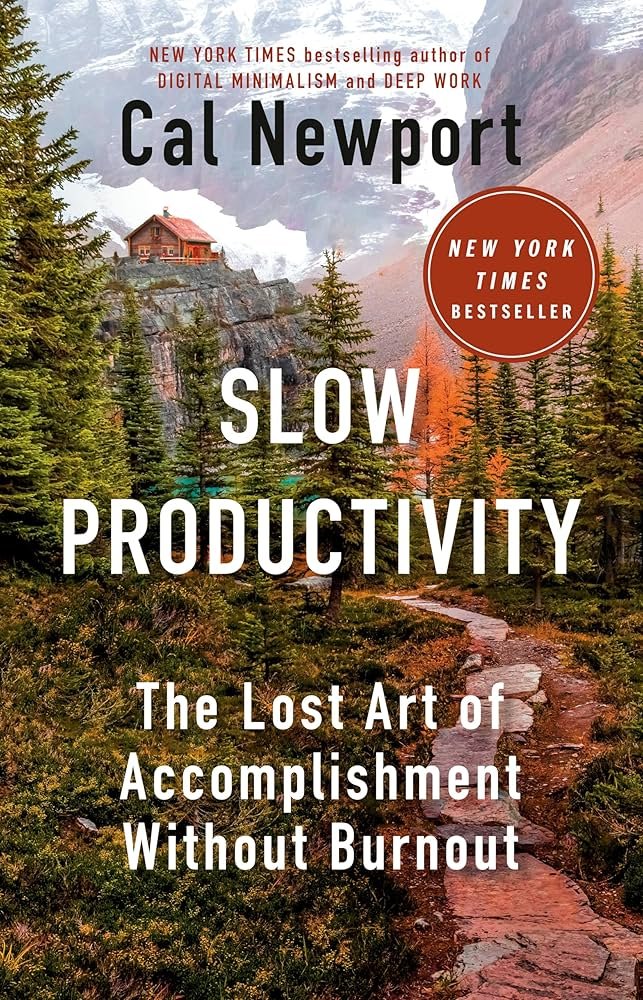
Book: Slow Productivity: The Lost Art of Accomplishment Without Burnout
Author: Cal Newport
Rating: 7.3 / 10
In one sentence: A well-crafted, deeply researched argument for a better way to work that stumbles on the gap between its idealism and the world most of us live in.
Worth the read? Yes. The first half will make you feel seen. The second half will test your patience. The core ideas are worth carrying.
The Review
Cal Newport has written a book that names something most knowledge workers have felt for years and never had language for. The term is "pseudo-productivity," and he defines it as the use of visible activity as a substitute for actual productive effort. I'd spent years calling the same phenomenon "performative." Newport is more precise. And for the first hundred pages, that precision feels like a gift.
His argument, stated plainly: knowledge workers have no agreed-upon definition of what productivity even means, and in the vacuum that creates, they've defaulted to looking busy as a proxy for being useful. The chimed-in email. The Slack message sent at 9 p.m. The "quick sync" that could have been a document. All of it, he argues, is theater, and it's killing the quality of the work. His alternative rests on three principles: do fewer things, work at a natural pace, and obsess over quality. Newport is a computer science professor and the author of Deep Work, which means his credibility here is rooted in the rigorous study of how creative and intellectual work gets done rather than lived practitioner experience. As a structure, it's clean. As a philosophy, it's compelling.

The book moves the way Newport says good work should: deliberately, without unnecessary acceleration. Each section introduces an idea, loads it with historical and biographical context, then offers practical suggestions. The literary examples (Kerouac, Mary Oliver, Ian Fleming, and others) are drawn with evident care. You sense that Newport has spent a long time inside these questions, and that confidence has a way of making the prose feel earned.
The confidence tips into blindness when he reaches for practical examples. The scenarios Newport proposes are, by his own admission, "laughably unobtainable" for most people. He concedes this, then keeps writing as if the concession changes nothing. There's a passage where he drafts a sample message a knowledge worker could send a colleague, essentially explaining they've decided they don't want to do the project the colleague is counting on them for. Newport presents it without irony. In any actual workplace, that message would end badly. The people this book would transform are a narrow subset of knowledge workers with unusual autonomy over their schedules. Newport knows this. He just doesn't reckon with it.
Then there's the question of speed. Newport never addresses the fact that the internet has made being first matter in ways it didn't for the historical figures he draws from. Jane Austen wasn't competing with a thousand other people publishing on the same subject the same week. Most knowledge workers are. His framework of working slower and obsessing over quality exists in real tension with a world that rewards publishing, shipping, and sharing before you're ready. For anyone building something in public, the advice to slow down and narrow focus runs into the reality that visibility and momentum carry their own kind of value. Quality, alone, can't replicate it.
None of that kills the book. The core ideas, stripped of the aspirational examples, hold up. The concept of the overhead tax (the idea that every new commitment brings with it a growing administrative drag that quietly halves your available time) is one of the more useful frameworks in recent productivity writing. "Do fewer things, work at a natural pace, obsess over quality" is a set of principles worth carrying forward.
Slow Productivity is best read as a philosophy rather than a manual. Take the ideals seriously. Be skeptical of the implementation. And maybe close Slack while you do it.
The Scorecard
I score every book I review against a weighted rubric. The criteria stay consistent. The scores don't.
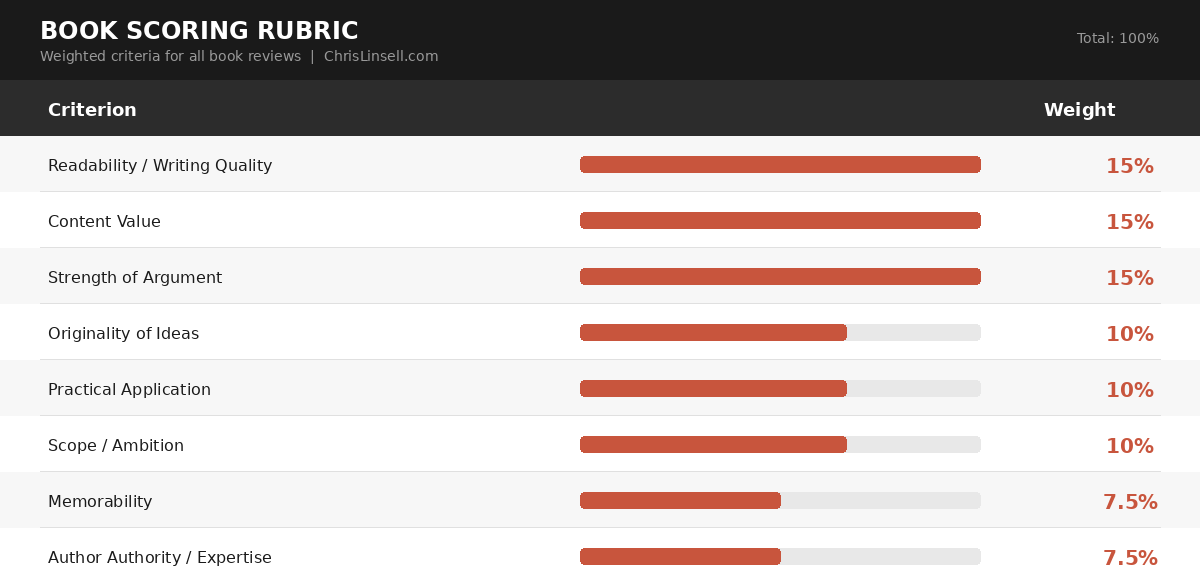
Here's how Slow Productivity landed.
Overall Score: 7.3 / 10
Readability (8/10): Newport writes with a structured, predictable clarity that makes the book easy to move through. He's a thoughtful communicator. The organization alone made me want to read his other work.
Content Value (7/10): The opening chapters landed in a way that felt uncommon. I walked away with three principles that feel mentally tattooed. By the midpoint, the content started feeling repetitive and oversimplified.
Strength of Argument (6/10): The theoretical argument is strong. The practical examples are where it falls apart. A sample colleague communication he proposes is, frankly, insane in any real workplace. By the middle of the book, the argument starts to feel like utopian fiction.
Originality (7/10): I can't remember an author who narrowed their focus and message the way Newport does here. I don't think I've read anyone who has thought as deeply about this specific topic. The deduction: by 150 pages in, the ideas largely weren't evolving beyond what the first hundred established.
Practical Application (5/10): This was the most contested dimension in my reading. Newport's implementation instructions are technically clear. I caught myself dismissing them without trying them, which is worth admitting. Even so, the principles are aspirational. They are not applicable as described to any realistic modern knowledge worker.
Scope / Ambition (7/10): The book takes on a large target: the structural failure of how knowledge work is defined and organized. The later sections hammer the same first principles repetitively, narrowing the felt scope of the second half.
Memorability (8/10): The overhead tax framework stuck hard enough that I was using it to reason through my own work patterns within days of reading it. The three pillars appear by name in my notes weeks later. Certain ideas felt convicting. I wrote "do less" in my journal on busy days.
Author Authority (6/10): Newport's expertise reads as that of a gifted researcher and communicator, not a deep domain practitioner. I would describe him to a friend as "a thoughtful storyteller" rather than "an expert in productivity." The disconnect from the realities of most knowledge workers leaves his credibility feeling bounded.
The Bottom Line
A 7.3 represents a book that delivered genuine value while leaving a real gap between its ambitions and its execution. Newport earns the score on the strength of his writing, the stickiness of his core ideas, and the depth of his conceptual framing. He loses it on argument strength and practical application, where the same tension surfaces again and again: the theory is compelling, the examples are fantasy.
This is a book that will influence how you think without convincing you that it describes a world you can live in. The people who need it most are the ones buried in the pseudo-productivity Newport diagnoses so well. They're the ones who can't afford to send that imaginary email declining a colleague's project. They're the ones whose Slack notifications won't wait for a "natural pace."
Newport wrote the book for the knowledge worker who deserves better. He couldn't write it for the one who exists. And the distance between those two people is where the entire productivity genre goes to die.