Daniel Coyle's The Culture Code Tells You Everything About the Leaders and Nothing About the Led
TL;DR
Book: The Culture Code: The Secrets of Highly Successful Groups
Author: Daniel Coyle
Rating: 6.8 / 10
In one sentence: A compelling, accessible argument for why the best teams feel safe before they feel smart, wrapped in storytelling so smooth it occasionally slides right past the hard questions.
Worth the read? Yes, with a caveat. If you have spent time thinking about leadership and team dynamics, you will recognize a lot of what is here. The value is in Coyle's narrative assembly, not necessarily in the originality of the ideas.
The Review
I picked up The Culture Code because I was about to walk into a new leadership role, and I wanted someone to challenge what I think I know about building teams. Coyle delivered on part of that. The other part, I had to supply myself.
The premise is straightforward: exceptional teams share a set of cultural behaviors that create belonging, build trust through vulnerability, and establish shared purpose. Coyle spent time embedded inside organizations ranging from Navy SEAL Team Six to Pixar to Danny Meyer's restaurant empire, and he reports back like a journalist who genuinely likes the people he is covering.
The writing is clean, fast, and light. Almost startlingly light. I read more pages in my morning sessions with this book than I typically do, and that is a credit to Coyle's prose. He writes business books for people who do not love reading business books, and he does it well.

But, that accessibility comes at a cost. The Culture Code cycles through the same two or three ideas across a dozen scenarios. Belonging. Vulnerability. Purpose. Each gets a new set of characters and a new setting, but the underlying argument could fit in 250 words. A part of me wondered, around page 120, whether this could have been a fantastic long-form blog article.
Coyle does not prescribe specific tactics (smart, since his audience spans militaries and middle schools), but he does mandate priorities. "Listen like a Trampoline" and "Resist the Temptation to Reflexively Add Value" stuck because they tackle the same instinct from different angles: the leader's job is to draw out, not to fill in.
The biggest gap in The Culture Code is the missing perspective of the people being led. Coyle spends almost all his energy on the culture builders and almost none on those who had to be transformed by the new culture taking shape around them. When he describes the Pixar and Disney Animation turnaround, we hear from the leaders. We do not hear from the animators. It creates an impression, probably unintentional, that the people inside these cultures are interchangeable parts rather than humans with their own resistance, skepticism, and eventual buy-in.
The closing pages work well. Coyle steps out of the rarefied air of SEALs and Pixar and describes building culture in a middle school writing club. Finally, a scenario that feels proportional to most readers' actual lives. I wish there had been more of that realism earlier.
If you have spent time with Simon Sinek's work, much of The Culture Code will feel familiar. The shared DNA is obvious. Where Sinek gives you the philosophy, Coyle gives you the field reporting. Whether that distinction justifies another 300 pages depends on how much you value the stories over the thesis. I did, mostly. The Culture Code will not shock anyone who has already thought seriously about leadership. It might give you the language for what you have been feeling, and sometimes that is exactly what you need.
The Scorecard
I score every book I review against a weighted rubric. The criteria stay consistent. The scores don't.
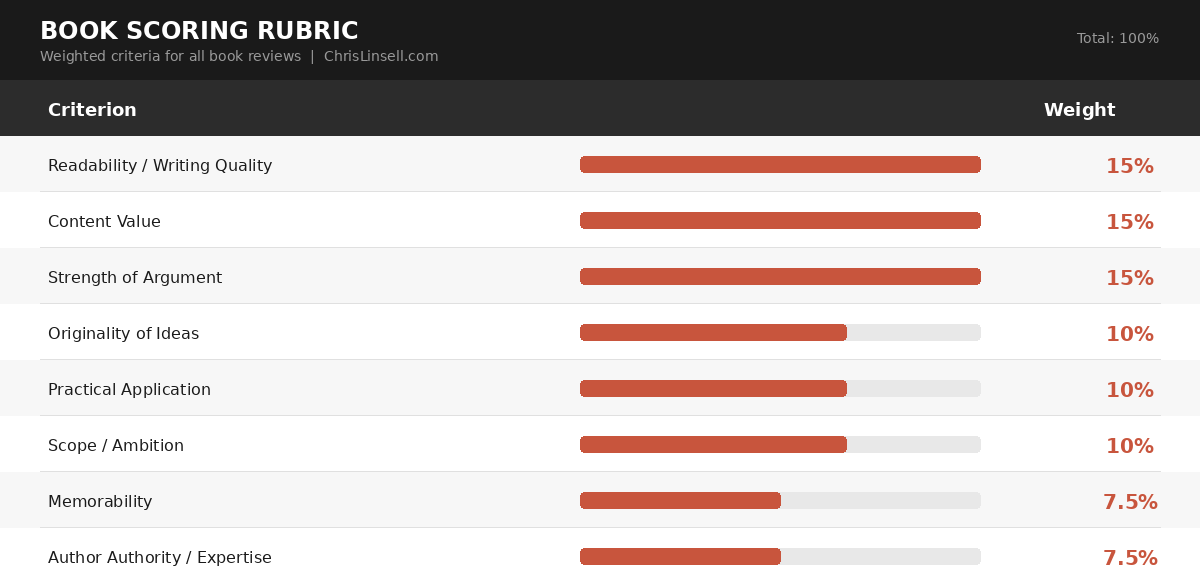
Here's how The Culture Code landed.
Overall Score: 6.8 / 10
Readability (8/10): Consistently strong across nearly every session. The prose was extremely accessible, reading sessions ran longer than usual, and the writing earned an 8/10 on enjoyment alone. The word "light" appeared repeatedly as both compliment and mild critique, but the net effect was clearly positive.
Content Value (6/10): Genuine value appeared in specific sections (Danny Meyer, heuristics, "Ideas for Action"), but the book cycles through the same two or three ideas repeatedly. Multiple sessions described wishing for more depth than the book delivers.
Strength of Argument (6/10): The absence of counterarguments was the recurring problem. The book presents culture building as if there is no other way, and the people being led are largely absent from the narrative. Within each example the logic was sound, but the argument's completeness suffered.
Originality (5/10): The assembly of ideas was fairly original, but the underlying concepts would be familiar to anyone who has read Simon Sinek or similar leadership material. This book will not shock anyone who has already thought seriously about leadership.
Practical Application (7/10): The "Ideas for Action" sections earned specific praise. The Bales statistic on questions generating 60 percent of discussion was highlighted immediately. "Listen like a Trampoline" and "Resist the Temptation to Reflexively Add Value" were actionable and sticky.
Scope / Ambition (5/10): The book felt narrow in its framing, describing a binary between winners and losers with no acknowledgment of the bell curve. The missing perspective of those being led, the lack of diversity in profiled leaders, and post-publication stumbles of featured organizations (Pixar, Zappos) all suggest the scope fell short.
Memorability (7/10): Several ideas stuck: the Bales statistic, the concept of heuristics, the servant leadership framing, and the closing anecdote about the middle school writing club. The theme of servant leadership was personally resonant.
Author Authority (7/10): Coyle was credible, particularly in his embedded, first-person investigative approach. The ability to connect personal observation to broader research came through. Docked slightly because he never acknowledged alternative perspectives, which would have strengthened rather than weakened his authority.
The Bottom Line
A 6.8 places The Culture Code in the "mixed, leaning positive" range. The book earned its points through exceptional readability, genuinely useful action-oriented sections, and a handful of ideas that lodged in the thinking. It lost ground on depth, originality, and a persistent unwillingness to engage with counterarguments or the perspectives of those being led rather than leading.
The deeper issue is one Coyle probably did not intend to raise: leadership books almost always tell the story from the top down. The leader sees the problem. The leader builds the culture. The team thrives. What is missing from every scenario in The Culture Code is what it felt like to be inside that transformation without having chosen it. The animator at Pixar who suddenly had a new boss with a new philosophy. The SEAL who had to trust a process he did not design.
Culture is not something leaders build alone. It is something they negotiate with the people who have to live inside it. Until leadership books reckon with that, they will keep producing the same clean, inspiring, incomplete story. Coyle tells it better than most. He just tells the same half.